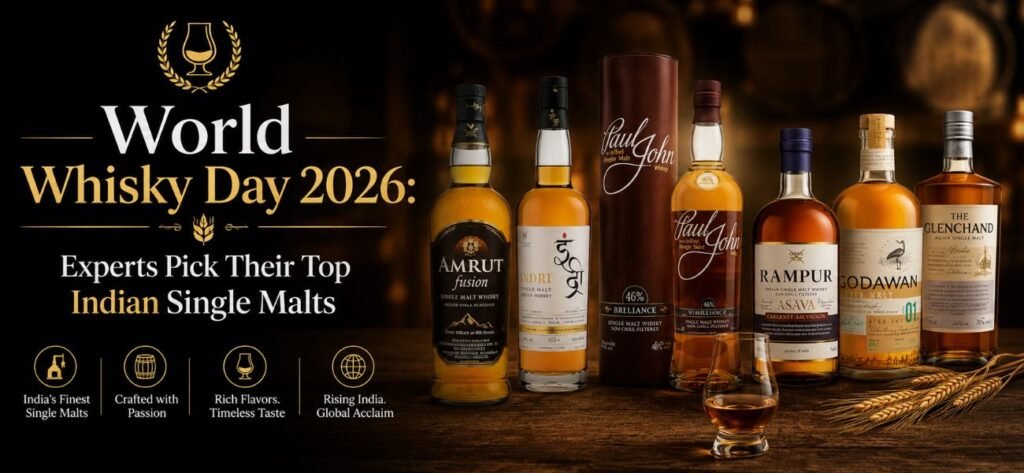

The Indian single malts have a historical inflection point on Saturday, 16 May: As the global whisky community toasts World Whisky Day 2026. It is one of the most awarded, fastest-growing, critically-acclaimed whisky categories on Earth – a far cry from what would have initially been dismissed as a curiosity. In fact, three out of the top ten whiskies in world rankings as of late are Indian, and producers like Amrut, Paul John and Indri–Rampur and Godawan have begun pouring into almost 80 countries.
This World Whisky Day 2026, we asked some spirits writers, master distillers, sommeliers and bartenders around India and abroad to tell us which Indian single malts they think every 21st-century whisky aficionado ought to pour,sip & sip. Whether from the tropical depth of Goa to absolute Himalayan precision in Jammu, here is the ultimate guide by the experts on how you should celebrate World Whisky Day 2026 as an Indian.
The Rise of Indian Single Malts: Why 2026 is Different
Glenfiddich or Glenlivet were the bywords for single malts in India for 30 years. The thought of an Indian single malt beating Scottish legends in blind tastings, five years ago would have caused an amused chuckle at any whisky club. That conversation has shifted dramatically since then and World Whisky Day 2026 arrives as the day when the world finally got with it.
It is a shift that is being carried by the climate and craftsmanship and confidence. Works on Indian distilleries are just not viable in Scotland. In hot, humid India, mean maturation environments leave the “angel’s share” (the whisky that evaporates through oak casks every year) running between 8–12% annually, as opposed to roughly 2% in Scotland. So the actual impact is major: a 5 Year Old Indian single malt has gone through more wood-spirit contact than a 12 Year Old Speyside. The end result is a daring, fruit-driven profile that something judges in London, San Francisco, and Frankfurt have begun to reward generously.
Founded in July 2024 (formally founded in March 2025) the Indian Malt Whisky Association (IMWA) has tightened the definition of what can be called an “Indian Single Malt.” The IMWA rules dictate that the whisky must have been produced at a single Indian distillery from malted barley, water and yeast; mashed, fermented and distilled in copper pot stills (no column stills); matured for three years minimum in oak casks no larger than 700 litres; and produced, bottled and labelled entirely within India. This clarity on regulation is one of the reasons why World Whisky Day 2026 is being celebrated with such confidence by Indian industry.
Read Also:- Fireball Cinnamon Whisky Price in India
The Experts’ Shortlist: Top Indian Single Malts for World Whisky Day 2026
We consulted a wide-ranging panel of experts — distillery veterans, global whisky judges, Mumbai sommeliers and award-circuit critics — to compile this expert shortlist for World Whisky Day 2026. Because seven names kept coming up, for particular reasons.
1. Amrut Fusion — The Pioneer That Still Sets the Standard
Amrut is to Indian single malt what a flagbearer is for each type of army Made in Bengaluru since the 1980s, Amrut first put Indian whisky on the world stage when it was released in Glasgow in 2004 and famously named one of the world’s best whiskies by Jim Murray.
For example the flagship expression of the brand, Amrut Fusion, combines 100% Indian grown unpeated barley with traditional Scottish peat barring creating a unique crossover between two whisky heritage’s. Experts highlight its rich golden hue, scents of tropical mango and peat smoke, and a palate brimming with vanilla, cloves, and a long warm finish complemented by smokiness.
Ahead of World Whisky Day 2026, one particular international whisky writer told us that: “Amrut Fusion is the bottle that showed the world that India could produce world-class scotch whisky, full stop.” “It is unrepentantly Indian, complex, and bold.” Fusion is definitely not what most would call easy drinking—Bottled at 50% ABV, it rewards attention and punishes the inattentive palate. Which is precisely why it keeps coming back to experts
Read Also:- Blenders Pride
2. Indri Trini — The Three-Cask Phenomenon
Where Amrut could rightly be described as the elder statesman, Indri is the wonderkid. Indri Trini, produced in Indri village, Haryana — India just below the foothills of the Himalayas by Piccadily Distilleries: The fastest-growing single malt globally with 170k cases sold worldwide since 2024 (resulted counter score).
The “Trini” means you’ll have 3 cask types during it’s maturation: ex-bourbon, ex-French wine, and ex-PX sherry. Casks are matured separately and then vatted together instead of finished one after the other. It combines a surprisingly complete character: toasted oak, honey, dried fruit, burned nuts, dark chocolate and orange zest.
At Whiskies of the World Awards, Indri Trini won “Best in Show”, and at World Whisky Day 2026 countdown, its peated sibling Indri Agneya received a Gold Medal at the World Whiskies Awards 2026 – with judges describing it as a green apple, sultana, subtle smoke and baking spice. If this is your first Indian single malt sampling (as you are celebrating the World Whisky Day 2026, when we spoke to experts around the country), almost all said — start with Indri Trini.
Read Also:- Best Whisky in India
3. Paul John Brilliance — Goa’s Coastal Masterclass
Made in Goa by the Paul John distillery, whisky like no Scottish distillery can make. The coastal heat and humidity speed maturation, the maritime air weighs most pronouncedly in cask interplay, and the resulting whiskies approach a tipa tiki roundness that has become Paul John’s hallmark.
Paul John Brilliance is the gateway to this house style — unpeated, matured in ex-bourbon casks crafted from American oak, and designed to be smooth and easygoing while also displaying genuine complexity. Experts rave about its honeyed sweetness, soft vanilla and mild oak structure. For more adventurous drinkers, Paul John Bold is a smokier, fiercer expression and veteran collectors can easily find Mithuna or Mars Orbiter.
Originally from India, Paul John has been gaining international acclaim since 2012 with multiple gold medals at the International Spirits Challenge, World Whiskies Awards, and San Francisco World Spirits Competition. One Mumbai-based sommelier described it in honour of World Whisky Day 2026: ‘If you want a true explanation of tropical maturation, pour Paul John Brilliance neat. Don’t rush it. Let Goa come to you.”
Read Also:- Best Single Malt Whisky in India
4. Rampur Asava — The Wine-Cask Wonder
Launched in 2016 specifically for the luxury market internationally, the Rampur range of single malt whisky is produced at one of India#x27;s oldest operational distilleries located in Rampur, Uttar Pradesh and owned by Radico Khaitan. None more importantly than in January 2026, where Rampur was rated as the fourth top trending whiskies worldwide by Drinks International, courtesy of bartender purchasing data from bars across the globe that lead the industry.
In particular, the unique feature here is Rampur Asava, matured in Indian Cabernet Sauvignon casks. It’s wine-led, plummy, softly spiced and unlike most things coming from Scotland. Rampur Select: The brand’s Speyside-style entry-level expression, Rampur Select is the gentler sibling—light, vanilla-forward and good for those that find Amrut too aggressive.
Select experts deem Rampur as the global ambassador for Indian single malt and the brand that has done more for luxury relinquishment for World Whisky Day 2026. The bottles sit comfortably between Macallan and Glenfarclas on the shelves of duty-free shops from Heathrow to Singapore.
Read Also:- Oaksmith Whisky
5. Godawan — Conservation in a Glass
Godawan, Diageo India’s first craft single malt made at the Alwar Distillery of Rajasthan and named after the endangered Great Indian Bustard. The heart of its range is Godawan 01, dosed with Pedro Ximénez casks, and Godawan 02, focusing on fruit and spice. Both expressions received Triple Gold at the Superior Taste Awards 2026 with scores of 92.8 and 90.1 each.
Godawan is significant for what it stands for away from the palate as well. It is the sole spirit distillery in Asia to have achieved the serious distinction of receiving Alliance for Water Stewardship (AWS) certification; Rajasthan is one of India’s most water-stressed states. In late 2025, Godawan released a special collector’s edition consisting only of 173 bottles – a tribute to the population of the Great Indian Bustard that remains alive. World Whisky Day 2026 feature The whisky as conservation statement
Read Also:- Green Label Price
6. GianChand — The Himalayan Outsider
The company, now known as DeVANS Modern Breweries, has been a single malt distiller since about 2022–23 when it turned its back on the Indian whisky tradition to make ultra-premium. The GianChand range — which is all named after Dewan and his sons (who also made their mark in the family owned brewery business) has been quietly turning heads ever since. In the heartland of Jammu — with its higher temperatures, accelerated maturation and more ostentatious house style — GianChand remained an outlier for geographical reasons.
At ISW Germany, the peated dictator beer, GianChand Manshaa, was named International Whisky of the Year 2025 with notes from judges of citrus and mild smoke with hints of salinity. GianChand Adambaraa- Indian Single Malt Whisky 2025– Best in Show, IndiaA whisky heralded for its rich oak, dried fruit and vanilla notes. Meanwhile the unpeated GianChand Signature, aged in American ex-bourbon casks offers an accessible entry level option at one of the most competitive price points available.
If you are into your whisky — and looking for something away from the obvious choices — then this World Whisky Day 2026, GianChand is the name whispered from across the bar by aficionados.
7. Kamet — The Master Distiller’s Encore
Surrinder Kumar, the erstwhile Amrut master distiller who is widely known as the “father of Indian whisky,”crea Политика цен на платный контент. Kamet ages its whisky in a meticulous blend of ex-bourbon, sherry and wine casks over 5 years, rooted in Kumar’s decades of experience to put forth a single malt that’s both well-rounded but layered—and one that packs far more complexity than its price point would suggest.
Kamet, named after the second highest peak in the Garhwal Himalayas, has been labelled a connoisseur’s choice – it is the bottle whisky writers are apparently all reaching for when asked which underrated Indian single malt deserves more love. It is dark horse for World Whisky Day 2026.
Indian Single Malts at a Glance: The Expert Comparison Table
If you are having a hard time making the call this World Whisky Day 2026, we’ve lined up two of India’s best-selling single malts side by side based on expert tasting notes, awards won, indicative price points and optimal drinking occasions.
| Whisky | Distillery & Location | ABV | Cask Profile | Key Tasting Notes | Indicative Price (750ml) | Best For |
| Amrut Fusion | Amrut Distilleries, Bengaluru | 50% | Ex-bourbon (Indian + peated Scottish barley) | Mango, peat smoke, vanilla, cloves, smoky warmth | ₹4,500–5,500 | Bold sippers, enthusiasts |
| Indri Trini | Piccadily Distilleries, Haryana | 46% | Ex-bourbon + ex-French wine + ex-PX sherry | Toasted oak, honey, dried fruit, dark chocolate, orange zest | ₹2,800–3,500 | First-time Indian single malt drinkers |
| Paul John Brilliance | Paul John Distillery, Goa | 46% | American oak ex-bourbon | Honeyed sweetness, vanilla, tropical fruit, gentle oak | ₹2,400–3,200 | Scotch drinkers exploring India |
| Rampur Asava | Radico Khaitan, Uttar Pradesh | 45% | Ex-bourbon + Indian Cabernet Sauvignon wine casks | Plum, red berries, soft spice, wine-led complexity | ₹8,000–10,000 | Luxury gifting, dinner pours |
| Godawan 02 | Diageo India, Alwar, Rajasthan | 46% | Bourbon + sherry (fruit-spice emphasis) | Orchard fruit, soft spice, subtle smoke, conservation story | ₹5,000–6,000 | Conscious drinkers, collectors |
| GianChand Manshaa | DeVANS, Jammu | 46% | Ex-bourbon, lightly peated | Citrus, gentle smoke, vegetal peat, saline finish | ₹3,500–4,200 | Adventurous palates, value seekers |
| Kamet Single Malt | Kamet, India | 46% | Ex-bourbon + sherry + wine casks | Honey, dried fruit, soft spice, balanced oak | ₹4,000–4,800 | Connoisseurs, master-distiller fans |
India is a large and complex country, which connotes wide variation in liquor taxation of different states. Goa and Karnataka generally have the lowest prices, with Haryana trailing close behind.
How Experts Are Tasting Indian Single Malts This World Whisky Day 2026
There is a small modification in technique necessary to taste Indian single malt properly. Due to the speeds with which India has matured, the spirit retains greater wood influence, more prominent tropical fruit notes and a fuller body than any concomitantly priced Scotch. The following is your consensus expert process for World Whisky Day 2026:
Use a tulip-shaped glass. This concentrates the aromas (some people prefer a Glencairn or copita). An okay way to drink it but most of the special things that make Indian single malt distinctive will be lost
Pour 30ml. Fight the generosity。 The all-time best way to explore whisky is in Single malt, poured slowly in small doses.
Nose first, then sip. Place it chin high, mouth slightly parted, draw breath through both nose and mouth. Indian single malts, on the flip-side deliver ripe tropical fruit, oak and — depending on the expression — a thread of peat or wine.
Add water, judiciously. With medium- or higher-strength products (e.g. cask strength expressions like Amrut), a few drops of room temperature water can reveal hidden flavours. Using ice is fine for a more casual pleasurable drinking but it hides the complexity.
Pair with Indian food. A lot of the experts we spoke to in advance of World Whisky Day 2026 told us that Indian single malts work better with Indian food than Scotch does. Good examples here are the peated Indri or Amrut which match excellent with smoky tandoori food. Try a sherried Rampur or Godawan and it can stand up to rich Mughlai gravies. Coastal Paul John and Goan seafood are a natural match.
The Global Recognition Story
One story told through numbers this World Whisky Day 2026. In 2024, Indri was declared the fastest single malt in the world. In the outset of 2026 Rampur was number four in the world trending whiskies. Paul John is the most awarded Indian distillery, having taken home more international medals than any other. Amrut Fusion is still one of the highest rated whiskies in Jim Murray’s Whisky Bible. Superior Taste Awards 2026 — Godawan wins Triple Gold. Won the title of International Whisky of the Year 2025 at ISW Germany: GianChand Manshaa
By these ‘good for India’ metrics, they don’t stack up. Blind tastings against Scottish, Japanese, Taiwanese and American competitors have established them as better than good. The category has range. It has character. And more and more it has choices at every price.
A Quiet Concern Worth Acknowledging
There is no WBW Day 2026 piece that covers Indian single malts that bypasses the water question. India’s major distilleries are now located in areas that are already vulnerable to measurable water stress — Rampur (Uttar Pradesh), Nashik (Maharashtra), the Nilgiris (Tamil Nadu) and Awar of Rajasthan. With groundwater withdrawals accounting for 25% of this resource globally, India is one of the highest at country level and 21 Indian cities may run completely dry by 2030 if current trends continue.
It takes tens of litres of water to create each litre of whisky. Alliance for Water Stewardship is the 1st organization which has certified Godawan as a spirit distillery in Asia. According to the IMWA, its members have SOPs for water recycling, effluent treatment and water reuse, which are reviewed on an annually basis It is truly an amazing awards story for the category. Its sustainability story is yet to be told.
What to Pour on World Whisky Day 2026: The Expert Recommendation Matrix
Now I have different bottles for different occasions. This is what the experts say should be enjoyed for World Whisky Day 2026:
- First Indian single malt ever: Indri Trini or Paul John Brilliance.
- For Scotch lovers where the weather becomes balmy: Amrut Fusion or Paul John Bold
- If you happen to be giving a tasting flight, pour Indri Trini, Amrut Fusion and Rampur Asava side by side. They are three different styles of house.
- Because if you really want to spoil someone, Rampur Asava, Paul John Mithuna or Godawan 02.
- If you are looking for an underrated find: GianChand Manshaa or Kamet.
When you require a peated dram for an evening of barbecue: Indri Agneya or Amrut Peated Cask Strength.
Frequently Asked Questions
Q1. When is World Whisky Day 2026 celebrated?
So, you have World Whisky Day 2026 on Saturday, May 16, 2023. It is celebrated on the third Saturday of May every year. The event started back in 2012 when whisky lover Blair Bowman was a student at the University of Aberdeen, Scotland.
Q2. Which is the best Indian single malt to try this World Whisky Day 2026?
The general consensus from experts is that Indri Trini (₹2,800–3,500), which also turned out to be the smoothest and most balanced of the bunch and had won multiple international awards too, is a good starting point. For those with more experienced palates, Amrut Fusion and Paul John Bold are arguably worth the splurge.
Q3. Are Indian single malts really comparable to Scotch?
Yes — and more often than not, they beat out Scotch of similar price in blind tastings. Like Scotch, Indian single malts are made from 100% malted barley in copper pot stills and aged in oak casks. India’s hot climate accelerates maturation and imparts a character of fuller-bodied, fruit-forward whiskies. Indian winners in the global top ten in recent years: three whiskies.
Q4. What is the angel’s share, and why does it matter for Indian whisky?
The angel’s share is the amount of whisky lost to evaporation, during maturation in cask. This will be around 2% per year in Scotland. In India, it is 8–12% per year due to high temperatures and humidity. This translates to further wood-spirit interaction in a shorter amount of time, giving rise to more intense flavour development.
Q5. How should I drink Indian single malt on World Whisky Day 2026?
Neat in a tulip-shaped glass, with some drops of water if desired. No ice for top expressions; it deadens the palate. Sip slowly, nose first. They also work superbly with Indian food — the tandoori, Mughlai and Goan.
Q6. What is the difference between Indri Trini and Indri Agneya?
Indri Trini — The flagship unpeated expression, aged in three different cask types (ex-bourbon, ex-French wine and ex-PX sherry). Indri Agneya is the fully peated version, mildly smoke dried with Scottish Highland peat at 25 ppm an
Q7. Where can I buy Indian single malts in India?
India has state-level liquor regulations that result in varying availability of that good. You will usually find the widest range from Karnataka, Maharashtra, Haryana, Delhi and Goa. Premium expressions are also available in duty free stores present at major Indian airports, oftentimes for competitive prices.
Q8. What makes World Whisky Day 2026 special for Indian whisky?
In recent times, Indian single malts reach the pinnacle of global recognition this year. Three Indian whiskies in the global top ten (Wrotham Manor is one of the trendy new types!), the launch of worldwide quality standards for Indian Malt Whisky courtesy of the Indian Malt Whisky Association, and brands like Indri, Rampur and Godawan winning at major international awards: World Whisky Day 2026- felt to many that it was when Indian single malt finally arrives fully on the world stage.
Q9. Is Indian single malt expensive compared to Scotch?
For the most part, Indian single malts offer better value. At ₹2,800–3,500a bottle for an Indri Trini or a Paul John Brilliance offers more flavour intensity than numerous 12-year-old blended Scotches available at the same price. High-end Indian expressions such as Rampur Asava and Paul John Mithuna are competing with the luxury bottles at mid-range in Scotch.
Q10. Are there any sustainability concerns with Indian single malt production?
Yes. Most Indian distilleries are located in areas that face water stress. At present, only Godawan is Alliance for Water Stewardship certified — the only such spirit distillery in Asia. The IMWA say that while member distillers have water recycling and effluents treatment SOPs, the industry has recognised there is more to be done.
Raising a Glass
Indian single malt: The story is not one of catching up That is, defining a new style — bolder, fruitier, more tropical and inherently Indian. World Whisky Day 2026 is but the ideal moment to sample that tale.
Pour something Indian this Saturday. Sip it slowly. And raise a glass to a genre which, until just about ten years ago, few thought possible. World Whisky Day 2026: Who will the experts be picking this year? The glass is yours.