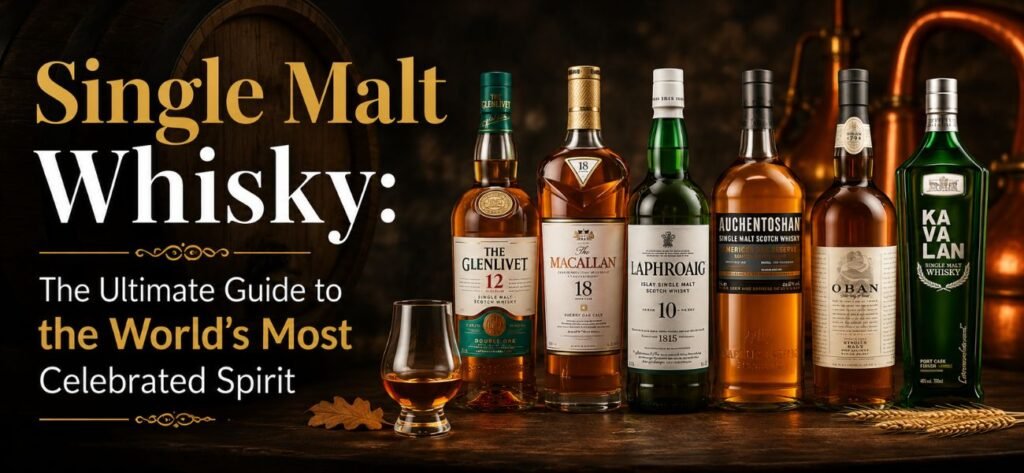

The single malt whisky is among the most traditional yet intricate liquor on earth. No matter your level of experience, knowing what makes single malt whisky so special is the first step on a deeply satisfying journey. Be it rich and peaty from the misty Scottish Highlands, light and floral from the rolling hills of Japan or even smooth silky Irish whiskey, single malt whisky has held its fascination for millions globally. This guide is going to give you an all-in-one accord: its history, how it is produced, and the regions behind this beverage as well as tasting notes, food pairings and much more.
What Is Single Malt Whisky?
A single malt whisky is a whisky that is:
- Consists solely of 100% malted barley as the only grain component.
- Made from one distillery process only (hence the single).
- Usually distilled in pot stills, mostly copper pot stills
- Having been matured in oak casks for a legally required minimum period (those periods are generally three years in Scotland).
Do not confuse single malt whisky with blended whisky. A blended whisky is a mix of malts and grain whiskies from different distilleries, while a single malt whisky has the unique characteristics of one singular distillery. This distinctiveness is the secret behind how connoisseurs across the globe cherish single malt whisky.
A Brief History of Single Malt Whisky
Single malt whisky can trace its origins to 15th century Scotland, with the first written record of monks distilling it from fermented grain mash attributed more specifically to Friar John Corr on December 1494. The Gaelic expression uisce beatha (water of life) worked its way to become the English word and spelling of “whisky.”
| Era | Milestone |
| 1494 | First recorded mention of Scotch whisky in the Exchequer Rolls of Scotland |
| 1644 | Scotland introduces the first excise tax on whisky |
| 1823 | The Excise Act legalises commercial distilling in Scotland |
| 1831 | Aeneas Coffey patents the continuous still (used for grain whisky) |
| 1915 | Immature Spirits Act mandates minimum three-year ageing |
| 1963 | Glenfiddich begins actively exporting single malt whisky globally |
| 1988 | Scotch Whisky Act formally defines categories of Scotch |
| 2009 | Scotch Whisky Regulations update and clarify the legal definition |
While those practices continued and expanded leading to the global boom of single malt whisky appreciation that started in earnest during the 80s and 90s as distilleries like Glenfiddich, The Macallan, and Laphroaig began promoting their expressions around the world. The single malt whisky market today is worth tons of billions and maintains its course in growth year by year.
How Single Malt Whisky Is Made
Single malt whisky is a multi-stage process which takes time, along with the best craft and natural ingredients. Here is a step-by-step overview:
1. Malting
Barley is soaked in water, and allowed to germinate (so that the starches become fermentable sugars). You dry the germinated barley (or “green malt”) in a kiln. And in the case of traditional Scotch distilleries, when kilning occurs to dry the malted barley, this is where the peat gets burned and provides that smoky earthy character found in many single malt whiskies.
2. Mashing
Dried, the malt is milled to a coarse flour known as “grist.” Mash: In a mash tun, hot water is added to the grist which dissolves the sugars to create a sugar-rich solution called wort
3. Fermentation
The wort is pumped into room temperature wooden or stainless-steel vessels known as washbacks and yeast is pitched in. The sugars are consumed within a period of 48 to 96 hours, and as yeast ferments the alcohol it creates. The result is called “wash” (which contains approximately 7–10% alcohol).
4. Distillation
The wash undergoes a double (triple in Irish distilleries) aeration process through pot stills made of copper. The first of the distillation gives you “low wines” at the approximate strength of 25% ABV. A second distillation yields 60–70% ABV new make spirit. The distiller takes care to separate the “heads” and the “tails,” or undesirable fractions from the heart of the spirit.
5. Maturation
The new make spirit is placed in oak casks generally ex-bourbon barrels from the USA or ex-sherry casks from Spain and allowed to mature for a minimum of three years. The wood and spirit passive play during this time adding colour, flavour and complexity. The longer a single malt whisky matures the more character it has, more nuances and layers.
6. Bottling
Once matured, the single malt whisky is either bottled at cask strength or reduced with water to a standard bottling strength (typically 40–46% ABV). Some expressions are non-chill filtered in order to retain these natural oils and flavour.
Major Regions of Single Malt Whisky Production
Scotland has five recognized whisky-making regions, and those geographical variations lead to more or less identifiable single malt whiskies. Outside of Scotland, there’s very strong reputations for high quality single malt whisky being produced in countries like Japan, Ireland, the US and India.
Scottish Regions at a Glance
| Region | Key Characteristics | Notable Distilleries |
| Speyside | Fruity, floral, honeyed, elegant | Glenfiddich, The Macallan, Balvenie, Glenlivet |
| Highlands | Diverse; heathery, fruity, sometimes peaty | Glenmorangie, Dalmore, Oban, Aberfeldy |
| Islay | Heavily peated, smoky, medicinal, coastal | Laphroaig, Ardbeg, Bowmore, Lagavulin |
| Lowlands | Light, grassy, floral, gentle | Auchentoshan, Glenkinchie, Bladnoch |
| Campbeltown | Briny, oily, complex, slightly peaty | Springbank, Glen Scotia, Glengyle |
International Single Malt Whisky Producers
| Country | Notable Producers | Style |
| Japan | Yamazaki, Nikka, Hakushu | Delicate, precise, floral, fruity |
| Ireland | Teeling, Waterford, Bushmills | Light, approachable, often triple-distilled |
| India | Amrut, Paul John | Tropical fruit, rich, fast-maturing |
| United States | Balcones, Westland, Stranahan’s | Bold, innovative, diverse grain profiles |
| Australia | Starward, Sullivan’s Cove | Fruity, wine-cask influenced |
| Taiwan | Kavalan | Tropical, creamy, wine-cask finish |
Reading a Single Malt Whisky Label
Knowing what it all means on a single malt whisky bottle will make your enjoyment of what you drink rise exponentially.
- Age Statement – The number you see on the label (e.g., 12, 18, or 25 years) shows the shortest period of time in which the whisky has been matured. You may also see something called an NAS, which means No Age Statement – it’s a single malt whisky offered without age, but can still be amazing.
- Alcohol by Volume (ABV): The majority of single malt whiskies are bottled between 40%–46% ABV. ABVs of cask strength expressions can be upwards of 60%.
- Cask Type: The type of cask used should be included on the label: ex-bourbon, ex-sherry, port, wine or double-matured.
- Distillery Name: As required by law, a whisky must only be distilled at that distillery to carry the name.
- Vintage: Certain bottles feature a vintage year which shows when the spirit was distilled.
How to Taste Single Malt Whisky Like a Pro
Single malt is something of a sensory pleasure that you can experience with sight, smell, and taste. Tasting Framework Here is a short framework for tasting:
Step 1: Appearance
At this stage measure in a tulip glass. Take it near the light and see what colour it is – pale gold to deep amber will tell you a little about cask type and age.
Step 2: Nosing
Gently swirl the glass around, before moving in for a sniff. Instead of taking a long inhale all at once, take a couple of very short and gentle sniffs. Look for any aromas: fruit, florals, vanilla, spice, smoke and oak; dried fruit.
Step 3: Palate
Small sip, and make sure the whisky coats your entire mouth. Make a record of how the texture (lite, medium or full) and what flavours are being released sweet, savoury, spicy, bitter or smoky.
Step 4: Finish
Take note of how long the flavours stay around following swallowing, what notes are present. I have long been taught that the longer and more complex a finish, the better sign it is of a high quality single malt whisky.
Step 5: Water
Just adding a few drops of still water will help Open up the aromas and soften the alcohol delivering even more layers of complexity to your single malt whisky.
Popular Single Malt Whisky Flavour Profiles
| Flavour Profile | Description | Recommended Expression |
| Fruity & Floral | Apple, pear, peach, honey, jasmine | The Glenlivet 12 Year Old |
| Rich & Sherried | Dried fruit, chocolate, Christmas cake, spice | The Macallan 18 Sherry Oak |
| Peaty & Smoky | Smoke, iodine, bonfire, sea salt | Laphroaig 10 Year Old |
| Light & Delicate | Grass, citrus, vanilla, light malt | Auchentoshan American Oak |
| Coastal & Briny | Sea spray, seaweed, brine, pepper | Oban 14 Year Old |
| Tropical & Exotic | Mango, coconut, passionfruit, vanilla | Kavalan Concertmaster |
Food Pairing with Single Malt Whisky
The single malt whisky combines wonderfully with an extensive array of meals that enhances the drink and food.
| Single Malt Style | Food Pairing |
| Light & Floral (Lowlands) | Sushi, light seafood, soft cheeses |
| Fruity & Honeyed (Speyside) | Dark chocolate, salmon, apple tart |
| Rich & Sherried (Highlands) | Aged cheddar, charcuterie, Christmas pudding |
| Peated & Smoky (Islay) | Smoked salmon, oysters, blue cheese |
| Tropical (Japan/India) | Mango desserts, spiced nuts, grilled chicken |
Collecting and Investing in Single Malt Whisky
Single malt whisky has established itself as a genuine alternative investment asset in the past few years. Bottles of single malt whisky are increasingly fetching tens of thousands sometimes millions at auction as the rarest and most coveted disappears. For the example, lesser-known Macallan 1926 Fine and Rare single malt whisky sold for £1.5 million-plus at auction to become one of the highest prices paid for a bottle ever.
Whisky collection tips:
- Target distilleries with good historical track records (The Macallan, Springbank, Karuizawa).
- Identify rare editions, single cask offerings and distillery owned bottlings.
- What is the best way to keep beer quality during storage?
- Always keep the bottles sealed; once opened, price drops near-vertical.
- Look for auction websites that focus on rare and collectible whisky.
The Future of Single Malt Whisky
Single malt whisky is changing fast. As for its future, some key trends shaping it include:
- Sustainable practices: Distilleries are turning to renewable energy, recycling water and lowering carbon footprints.
- Casks and Micro-Distilleries: New’ wave growing some boundaries of what single malt can fairly be construed as
- Global Reach: Countries from France to Sweden, South Africa to even China are making awesome single malts.
- Experimental Casks: Strange Oaked Finis Like rum, tequila and cognac-filled barrels leading to delightful new flavours.
- Transparency: Consumers want to know how products are made, the types of casks used for maturation, and where they were sourced.
Frequently Asked Questions
Q1. What is the difference between single malt whisky and blended whisky?
Single malt whisky comes from 1 distillery and is comprised of 100% malted barley, whereas blended whisky consist of both malts and grain spirits from more than one distillery. Single malt Whisky is representative of one distillery’s unique character.
Q2. Does single malt whisky always come from Scotland?
No. Scotland is of course the consummate producer of single malt whisky but such amazing single malts are also produced outside Scotland including Japan, Ireland, India, Taiwan and the United States among other countries.
Q3. Is older single malt whisky always better?
Not necessarily. Age is also a factor of complicating things with older single malt whisky, not necessarily the best. Most 10 and 12 year expressions are the finest, note to mention some older expressions tend to be over-oaked or make excessive burn.
Q4. What does “cask strength” mean on a single malt whisky bottle?
Cask strength single malt whisky is the product that has been bottled without dilution at its natural ABV usually in the range of 55%–65% abv. These expressions are bolder and have more punch, where aficionados can add water to their preferred strength.
Q5. How should I store an open bottle of single malt whisky?
Keep your opened bottle of single malt whisky upright, out of direct sunlight and heat. If they are less than 50% full consider decanting this into a smaller bottle to reduce the air, which will oxidise and affect flavours.
Q6. What is the best glass for drinking single malt whisky?
A Glencairn glass, or even a tulip-shaped nosing glass is seen as perfect for any single malt whisky due to its narrow rim which helps to concentrate aromas and enrich the taste experience.
Q7. Should I add water or ice to single malt whisky?
Some whisky masters even recommend adding a few drops of still water to expand the aromas arising from a single malt. On the other hand, ice cools the soul and stifles both smell and taste which is rarely advisable for quality single malt.
Q8. What is a non-chill filtered single malt whisky?
Non-chill filtered means the single malt whisky has not been through a cold filter prior to bottling. This maintains the natural oils and fatty acids that help to create a fuller mouthfeel and more complex flavour, although if chilled or water is added the whisky may appear cloudy.
Conclusion
Single malt whisky is not only a beverage, but also a lens through which to view geography, history, craftsmanship and time. Every bottle of single malt whisky has a story to tell – from an Islay sooty coal pit to the glamourous palaces of Speyside and even tropical warehouses in India. Whether you are curled up by a fire with a peated Islay dram, or seeking out the intricate florals of a Japanese expression, single malt whisky provides an unparalleled breadth of experience.
With single malt whisky still riding the worldwide wave of interest there has never been a better time to delve into this glorious spirit. So take a relaxed approach, trust your taste buds and enjoy – single malt whisky is just the start of the journey.